
Why Do Batteries and Alternators Cost More Now?
Modern vehicles ask much more of their electrical systems. Many need larger AGM batteries that must be registered to the vehicle's battery management system, and both batteries and alternators are often buried behind other components.
At our Port Coquitlam shop, a battery replacement typically costs approximately $270 to $440 before taxes, and an alternator replacement approximately $475 to $970. Testing first matters, because a weak battery, a failed alternator and a wiring fault can all look the same.
Why car batteries and alternators cost more than they used to, and why replacing the wrong part can leave you stranded.
A customer recently brought his BMW into our Port Coquitlam shop with electrical problems. He was convinced the battery couldn't be responsible, because he'd just had it replaced somewhere else.
When we finally got to the battery, we found the problem. The wrong battery had been installed. It was undersized, it wasn't the required AGM type, and it was so small it wasn't even properly secured in the original hold-down.
The customer was understandably frustrated. He'd already paid $250 for that battery.
The interesting part? $250 wasn't unreasonable for the battery he'd received. It simply wasn't the right battery for his vehicle.
The correct replacement, including installation, registration and resetting the vehicle's electrical features, came to approximately $800. It solved his problems, and the original shop refunded his previous purchase.
It's a good example of how much automotive technology has changed. A battery or alternator replacement isn't always the straightforward repair it once was.
The Short Answer
Car batteries and alternators have become more expensive to replace for three main reasons:
- Modern vehicles demand more from their electrical systems. Larger batteries, AGM technology, automatic start-stop and electronic battery management have changed what a replacement requires.
- Labour and programming have increased. Batteries and alternators can be buried beneath other components, and replacing them may require electronic registration, calibration or resetting vehicle features.
- Diagnosis is more complicated. A weak battery, a failed alternator, a wiring fault or a control-system problem can produce similar symptoms. Replacing a part without finding the actual cause can waste hundreds of dollars.
Here's what we're seeing in our shop, including real examples of repairs we've done.
Why Are Car Batteries So Expensive Now?
Think about how much vehicles have changed.
Years ago, a basic Toyota Corolla rolled on inexpensive 14-inch tires. Today, plenty of vehicles have large, low-profile wheels and performance tires that cost considerably more.
Batteries have followed a similar path.
Many modern vehicles need larger batteries with more capacity and more advanced technology. One of the biggest changes has been the move to AGM (Absorbent Glass Mat) batteries.
AGM batteries are built to handle heavier cycling and support vehicles with more sophisticated electrical systems. They generally cost more than conventional flooded lead-acid batteries.
Some vehicles use enhanced flooded batteries (EFB) instead. What matters is that the correct technology, capacity and specifications are matched to the vehicle.
Battery makers say the same thing. In a start-stop vehicle, the replacement must be a type approved by the vehicle manufacturer, and the job can take up to 28 separate steps, according to one battery maker's replacement guide.
Installing a cheaper conventional battery in a vehicle designed for AGM isn't really saving money. As our BMW customer discovered, it can create new problems.
Why replacing a BMW battery can approach $900
We service a lot of BMWs, and their batteries can be enormous.
Some models were offered with three different battery capacities. Even calling the dealership with the vehicle information doesn't always tell us which one is installed, and we often find the largest option once we get to it.
Getting to it can be a job in itself. The battery may sit beneath the trunk floor, behind several covers, with wiring and multiple hold-downs to remove.
Once the correct battery is in, we register it to the vehicle's battery management system. Depending on the model, we may also need to recalibrate the automatic windows and restore radio or clock settings.
Some of these replacements can approach $900.
It isn't just European vehicles
On certain Ford Edge models, the battery sits deep beneath the cowl. Removing the air box and surrounding covers turns a battery replacement into a half-hour job.
Other vehicles hide the battery under a seat or behind interior panels.
The days of lifting the hood, loosening two terminals and swapping a battery in ten minutes aren't completely gone. But they're no longer something you can assume.
Why Don't Car Batteries Last as Long as They Used To?
This is something we've noticed over the years.
Around Port Coquitlam, we used to regularly see batteries last six or seven years without much trouble. Today, we more commonly see four to six years.
At first, we wondered whether battery quality had declined.
But other independent repair shops using different battery brands told us they were seeing the same thing. Our battery representative also pointed out that many familiar battery brands come from a relatively small number of major manufacturers.
The bigger change isn't who makes the battery. It's what the battery is being asked to do.
Modern vehicles have a lot more electrical equipment
Think about what's in a typical newer vehicle: heated and cooled seats, power windows and seats, sunroofs, cameras, multiple displays, charging ports, electronic control modules, sophisticated lighting, and sometimes add-ons like dash cams.
Not everything runs at once, and the alternator supplies most of the power while the engine is running. But the electrical demands and management systems are far more complex than they used to be.
Some systems keep monitoring the vehicle even after you've parked and locked it.
Add short trips, frequent starts, long periods of sitting and batteries that aren't always fully recharged, and it's easy to see why battery condition matters more than ever.
Does automatic start-stop shorten battery life?
Start-stop systems do put extra cycling demands on a battery. But vehicles with these systems are designed to use batteries that can handle that extra work.
We wouldn't blame start-stop alone for the shorter battery life we're seeing. It's one part of a much larger change in how vehicles use and manage electricity.
Why Does a New Battery Need to Be Registered or Programmed?
This is one of the biggest changes customers don't see.
Many modern vehicles use a battery management system (BMS) to monitor battery condition and help manage charging. It may track the battery's age, state of charge, temperature and electrical demands.
As a battery ages, the vehicle adjusts its charging strategy.
When a new battery is installed, some manufacturers require it to be registered, or the battery management system reset, so the vehicle manages the new battery correctly.
Skipping this step can lead to incorrect charging, shorter battery life and extra demand on the charging system.
A Ford with two separate battery drains
We recently inspected a Ford whose owner was having repeated battery problems.
He'd already been to another shop, had a new battery installed, and was still dealing with the same issue. The previous shop had identified an electrical draw, and he came to us for a second opinion.
During our diagnosis, we isolated a significant parasitic draw in the trailer wiring. That was one problem.
But after isolating the trailer circuit, we kept monitoring the vehicle while its electronics were supposed to be asleep. We saw small, consistent spikes in electrical consumption.
After a battery management system reset, those spikes stopped.
Here's why that matters. Those smaller spikes probably wouldn't have drained the battery overnight on their own. But repeated unnecessary consumption gradually lowers a battery's charge. If normal driving doesn't replace that energy, the battery spends more time at a lower state of charge.
That shortens battery life and leaves the alternator working harder to catch up.
Had we stopped after finding the trailer wiring, we could have missed a second contributing factor. Finding one problem doesn't always mean you've found every problem.
That's why proper battery replacement and electrical diagnosis are about more than installing a new part.
That Battery Warning Light Might Not Mean You Need a Battery
This is probably one of the most misunderstood warning lights on a vehicle.
A little red battery symbol appears on the dash, so naturally, people assume the battery is failing. It makes sense. It's a picture of a battery.
But that light usually points to a problem with the charging system, not necessarily the battery itself. Perhaps it should just say "Charging System."
Here's a situation we see often. A customer notices the battery light and replaces the battery. The vehicle starts normally again, and sometimes the warning even disappears for a while.
Problem solved? Not necessarily.
If the alternator isn't charging properly, that new battery is simply supplying stored electricity to keep the vehicle running. Once it's depleted, the warning returns and the vehicle may leave the driver stranded.
We then end up diagnosing the charging fault, fully charging and testing the battery, and replacing the alternator if testing confirms it has failed.
Customers sometimes feel foolish for having bought a battery. But there's another side to the story. The original battery may genuinely have been weak and near the end of its life. A deeply discharged battery that struggles to hold a charge puts extra load on an alternator that's already working hard.
Batteries and alternators work together. A problem with one can affect the other.
One important note: if the charging-system light comes on while you're driving, don't assume you can safely carry on. The vehicle may be running on limited stored battery power and could eventually stall. Whether you're on the Lougheed Highway or the Mary Hill Bypass, find a safe place to stop and have the charging system checked. If another warning comes on with it, our guide to check engine light diagnosis explains what to do next.
Why Do Shops Charge to Diagnose an Alternator?
We understand this question. An alternator is either charging or it isn't, so why does it need a diagnosis?
Twenty years ago, checking the charging voltage was often enough to spot a straightforward alternator problem.
But modern charging systems are controlled much more precisely by the vehicle's powertrain control module (PCM). The PCM may raise or lower alternator output depending on battery condition, engine operation and electrical demand.
So a low or changing voltage reading doesn't automatically mean the alternator has failed.
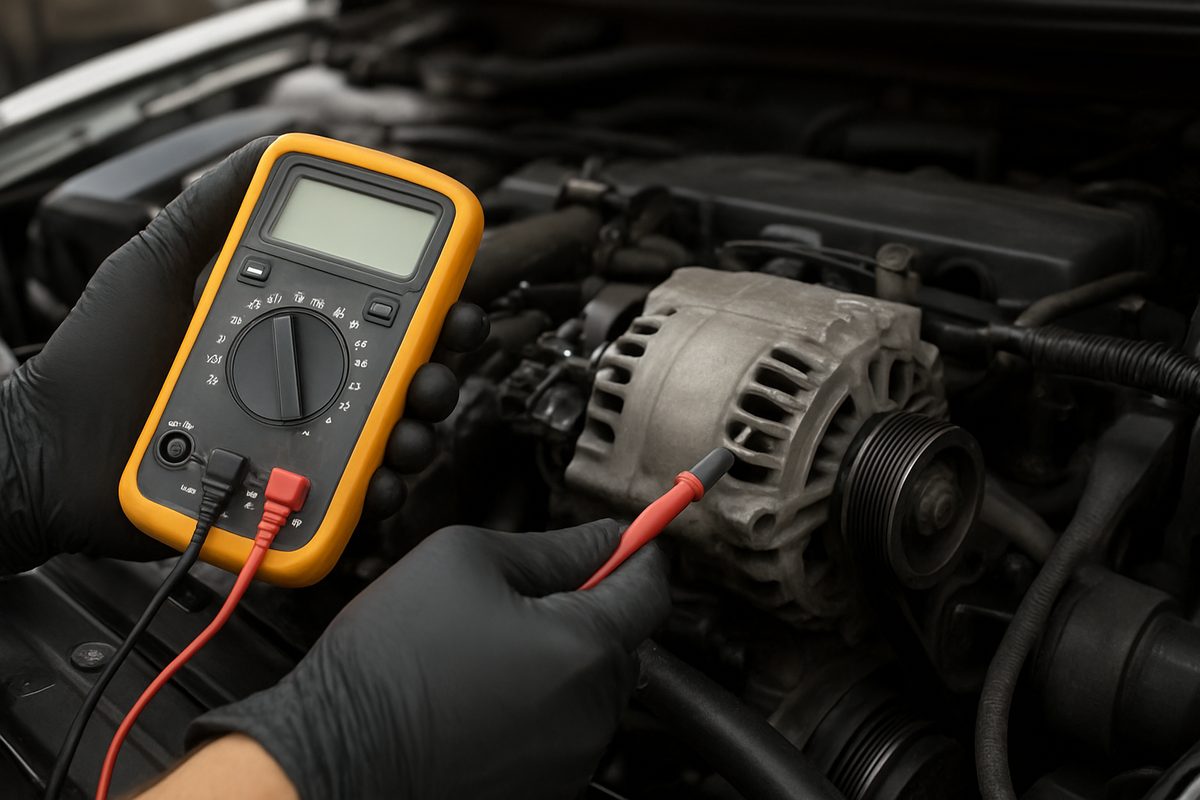
Before we recommend replacement, our technicians verify that the alternator has what it needs to work. That includes checking power supplies, grounds, wiring connections, control signals, commanded operation and, where appropriate, electrical waveforms.
We've seen plenty of cases where the alternator wasn't the problem at all. A bad connection, a damaged wire or a control-system fault was stopping it from charging correctly. Replacing the alternator wouldn't have fixed the vehicle.
These aren't extra steps we've recently added. It's how we've always approached electrical diagnosis.
You're not paying us to tell you the alternator isn't charging. You're paying us to find out why. That's also why a proper diagnosis can save money, even though it has an upfront cost.
We explain this in more detail in why auto repair shops charge for diagnostics.
Why Are Alternators So Expensive to Replace?
Alternators have changed too, but one of the biggest factors in the cost is simply how hard they are to reach.
On some vehicles, the alternator is right there. On others, it can take several hours just to remove and reinstall it.
We've worked on older all-wheel-drive Ford Escapes where the alternator sits at the back of the engine. Depending on the model, the job can take around three hours and involves working around driveline components.
A recent MINI Cooper was another example. To replace its alternator, we had to move the front end into service position, which means substantial disassembly just to get access. The complete job took nearly four hours.
Customers understandably compare this with what an alternator replacement used to involve. But when a manufacturer places a part behind other major assemblies, that labour can't be avoided.
How hard the alternator is to reach can affect the final invoice as much as the price of the alternator itself.
What Causes an Alternator to Fail?
Alternators can fail electrically, but modern ones also have mechanical parts that wear or get damaged. And sometimes the real cause has nothing to do with the alternator.
Oil contamination: our MINI Cooper example
The MINI Cooper mentioned above had an interesting history.
The owner had topped up the engine oil but accidentally left the oil filler cap off, then drove several kilometres. Oil escaped from the engine and found its way into the alternator.
Once oil gets into the internal components, cleaning the outside usually isn't enough to save it. Several weeks later, the alternator failed.
Add the nearly four hours of labour to reach and replace it, and an overlooked oil cap became a significant repair.
We also see alternators soaked by engine oil leaking from other places. Whenever contamination is part of the failure, finding and fixing the source protects the new part. It's one more reason we look for leaks during every oil change.
One-way alternator clutch pulleys
Another part many drivers have never heard of is the one-way alternator pulley.
Older alternators used a solid pulley. Many modern systems use an overrunning clutch pulley that absorbs changes in engine speed and reduces vibration in the accessory belt system.
These pulleys can wear, seize, slip or get noisy. We've seen alternators that were still charging perfectly but had a failed one-way pulley.
In one case, we had the special tool to replace the pulley and could buy it separately. But we still had to remove the alternator from the vehicle to do it. On some vehicles, the pulley isn't sold separately, so the whole alternator has to be replaced.
A failing pulley often shows up as belt noise or chirping first. Our post on serpentine belt replacement covers what those noises can mean.
An alternator doesn't have to stop charging to have a mechanical failure.
If My Alternator Fails, Do I Really Need a New Battery Too?
Not automatically.
We understand why customers ask. If you're already paying for an alternator, the last thing you want is another expensive part on the invoice. But the answer should come from testing, not guessing.
When an alternator fails, the battery is usually heavily discharged. Putting a charger on it and getting the vehicle running again doesn't tell us whether that battery is still healthy.
So we fully charge the battery, then run a proper battery health and load test.
In our experience, many of these batteries are already four years old or more. And here's something we've noticed over the years: only around three in ten batteries we test after an alternator failure recover to above 75% state of health after a full charge.
That means many were already near the end of their life, or had deteriorated enough that replacement makes sense.
The state-of-health threshold we follow is 75%. Below that, we recommend replacement. Cold cranking amps (CCA), age and test performance also factor in.
If the battery is healthy, we'll tell you. There's no reason to replace a good battery just because the alternator failed. But installing a new alternator alongside a battery that's already failing isn't much of a fix either.
The goal is to return the whole charging system to reliable operation.
How Much Does Battery or Alternator Replacement Cost in Port Coquitlam?
There isn't one honest price that covers every vehicle.
A conventional battery in an easy-to-reach spot is a quick job. A large AGM battery in the trunk of a BMW, with registration and setup, is a very different one. The same goes for alternators: an accessible one needs relatively little labour, while a MINI Cooper or certain AWD vehicles can take several hours.
So rather than quote national averages, here's what drivers from Port Coquitlam, Coquitlam and Port Moody actually paid at our shop. These figures come from our own repair records between July 2024 and October 2026, and are before taxes.
Battery replacement
A battery replacement at our shop typically costs approximately $270 to $440 before taxes, with many around $315. That includes the battery, installation, and any registration or reset the vehicle needs.
Larger AGM batteries in European vehicles commonly come in around $550 to $650, and the most involved installations can approach $900.
Alternator replacement
An alternator replacement typically costs approximately $475 to $970 before taxes, with many around $650. That covers the alternator, the labour to replace it, and shop supplies.
Accessible alternators on simpler vehicles can come in under $400. Vehicles where the alternator is buried, like the MINI and AWD Escape above, can pass $1,500.
These replacement figures don't include diagnosis. When a charging-system diagnosis is needed first, it's a separate line on your invoice: our Level 1 Diagnostic is $175 before shop fees and tax. Our other standard rates are on our price list.
These numbers show what a typical repair costs, but vehicle design and the reason for the failure can make an individual repair much more expensive. That's why we give you an estimate only after confirming the correct parts and repair procedure for your vehicle.
How Can You Avoid an Unexpected Battery Failure?
One of the simplest ways is regular testing.
We test batteries during routine maintenance whenever they're accessible, and the results appear in your digital vehicle inspection. For many of our regular customers, that's about twice a year.
We look beyond whether the vehicle starts. We check the battery's condition, state of health and cold cranking performance.
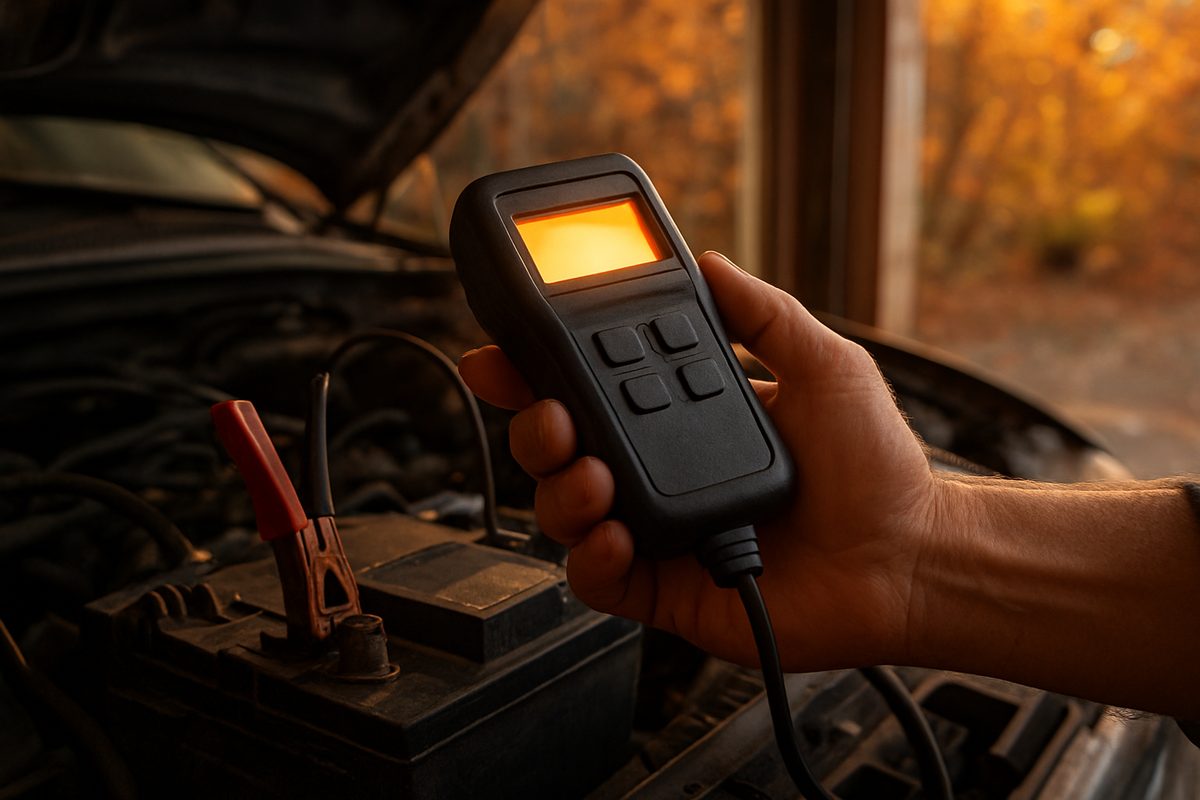
A battery can start a vehicle perfectly well in summer while already showing signs of wear. Heat speeds up battery aging, but here in the Lower Mainland it's often the first cold, wet snap in the fall that exposes a weak battery.
We've tested batteries during summer maintenance at around 70% state of health, and the customer tells us the vehicle feels perfectly fine.
Then the temperature drops. Suddenly the vehicle won't start, and it feels like there was no warning.
But the warning was there in the test results. The cold weather didn't kill the battery. It exposed a battery that was already getting weak.
That's why we believe in proactive maintenance rather than waiting for something to fail. For seasonal tips, see how BC winters affect car batteries.
The Bottom Line: Test First, Replace What Actually Needs Replacing
After more than 20 years in automotive repair, one thing hasn't changed: customers want their vehicles fixed properly, at a fair price, without unnecessary repairs.
What has changed is the technology. Modern batteries are larger, more specialized and more closely tied to the vehicle's computers. Alternators are electronically controlled, sometimes mechanically more complex, and often much harder to reach.
And when either one fails, the symptoms don't always tell the whole story.
That's why, for drivers across Port Coquitlam, Coquitlam, Port Moody and Pitt Meadows, we check the complete system, find the root cause and explain what we found before recommending a repair.
Sometimes the answer really is as simple as a new battery. Other times, that inexpensive fix turns out to be the first of several repairs because the original problem was never found.
Having the right diagnosis matters just as much as having the right parts.
— Brandon & the team at NAPA AUTOPRO - Poco Automotive
Common Questions
How much does it cost to replace a car battery in Port Coquitlam?
Based on our repair records, a battery replacement typically costs approximately $270 to $440 before taxes, with many around $315, including installation and any registration the vehicle needs. Larger AGM batteries in European vehicles commonly cost $550 to $650, and the most involved installations can approach $900.
How much does an alternator replacement cost in Port Coquitlam?
An alternator replacement at our shop typically costs approximately $475 to $970 before taxes, with many around $650. Vehicles where the alternator is hard to reach can cost more. Diagnosis, when needed, is billed separately.
Can I replace an AGM battery with a regular battery?
If your vehicle specifies an AGM battery, the replacement needs to meet the manufacturer's requirements. Installing the wrong battery type or capacity can lead to poor performance and premature failure.
Does every new car battery need programming?
No. Some vehicles need no electronic procedure, while others require battery registration, a battery management system reset or other recalibration. It depends on the manufacturer, model and electrical system.
Why does my brand-new battery keep dying?
A new battery won't fix a faulty alternator, an excessive parasitic draw or an electrical management problem. The cause of the discharge needs to be diagnosed.
Can a bad alternator damage a new battery?
Yes. A faulty charging system can leave the battery repeatedly undercharged or, in some failures, overcharged. Both can damage a battery and shorten its life.
Can a weak battery damage an alternator?
A weak or deeply discharged battery can place sustained charging demands on the alternator, increasing heat and wear. Not every weak battery will cause an alternator failure, but leaving a deteriorating battery in service adds stress to the system.
How long should a car battery last in BC?
From our experience servicing vehicles in the Tri-Cities, battery life is now commonly around four to six years, compared with the six or seven years we used to see. Actual life depends on battery type, vehicle, driving habits and maintenance.