
The Short Answer
A clogged air filter won't strand you, but it quietly makes your engine work harder and costs you money the longer it sits.
- It hurts more than fuel economy — restricted airflow makes the engine run rich, causing rough idle and sluggish throttle, and can even trip the check engine light.
- There are two filters, not one — the engine air filter protects the intake, and the cabin filter cleans the air you breathe and keeps strain off your blower motor.
- Inspect yearly, don't just watch the calendar — gravel roads, traffic, and construction clog filters faster, so we check both on every vehicle and replace them only when they need it.
Here's what's actually happening under the hood.
Air filters are one of those services that's easy to skip because nothing dramatic happens when you do. Your car still starts, still drives, still gets you where you're going — for a while. But a clogged filter is quietly making your engine work harder than it should, and the effects compound the longer it sits. Here's what's actually happening under the hood.
Your Engine Is Essentially Trying to Breathe Through a Dirty Sock
Internal combustion engines need a precise mix of air and fuel to run cleanly. A rough rule of thumb is about 14.7 parts air to every 1 part fuel. When a filter gets clogged with dust, pollen, bugs, and road debris, that airflow gets restricted. The engine management system compensates as best it can, but it can only do so much. The result is a richer-running engine — more fuel than intended — which shows up as reduced fuel economy, rougher idle, and sluggish throttle response.
It Can Trigger the Check Engine Light
Modern vehicles have an oxygen sensor downstream of the combustion process. When the air/fuel ratio runs too rich for too long, the ECU flags it. Depending on the vehicle, this can set a code and light up the check engine light — which now has to be diagnosed and cleared. What started as a $30 filter replacement becomes a diagnostic visit on top of it. We've seen this more than once.
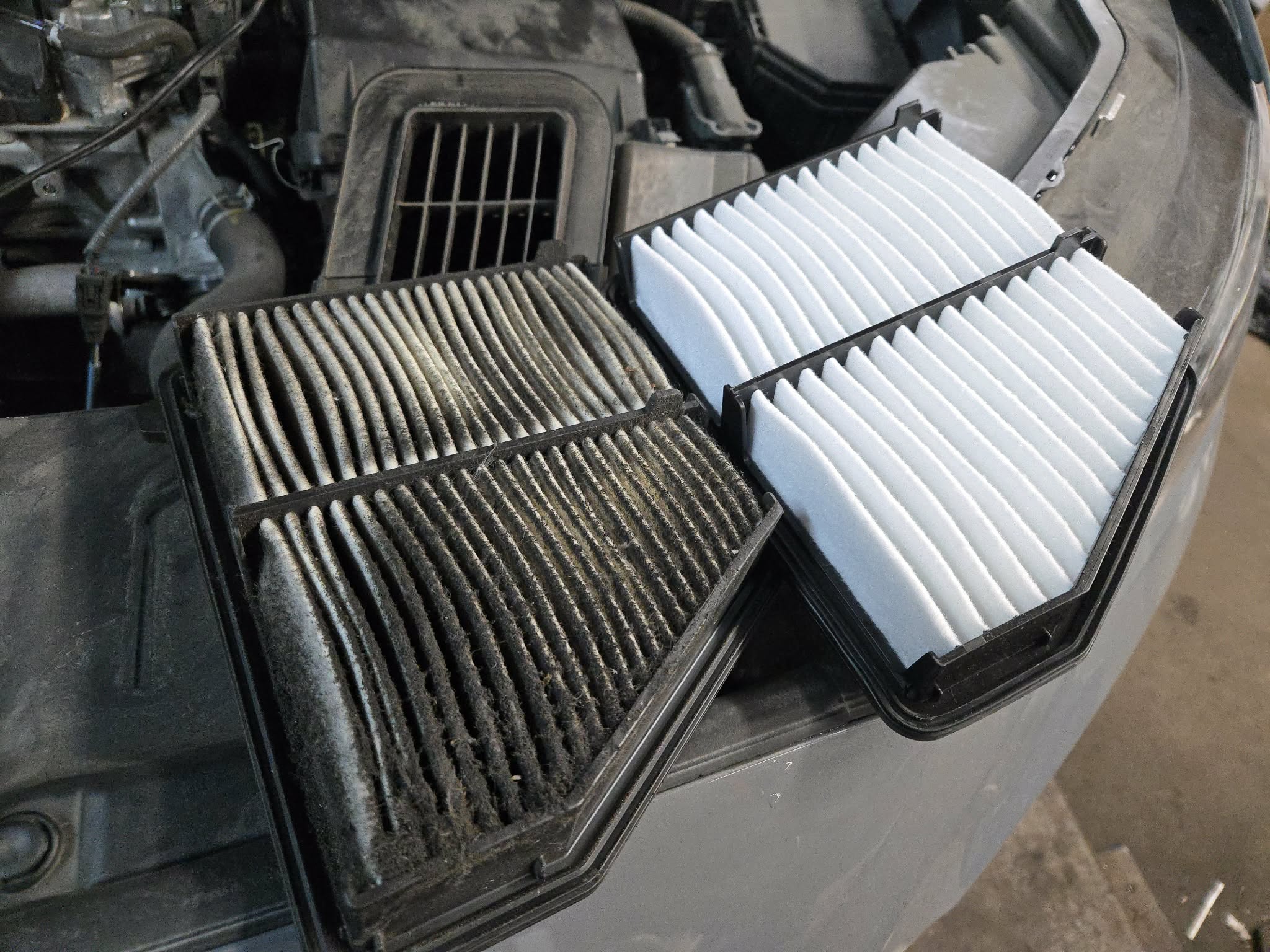
There Are Actually Two Filters — and Most People Forget One
Your vehicle has an engine air filter that protects the intake, and a cabin air filter that cleans the air coming into the passenger compartment through your HVAC system. Both need to be replaced regularly. The cabin filter is the one we pull out most often that people have never heard of. When it's clogged, your heat and A/C have to work harder to move air, which puts strain on the blower motor — a much more expensive fix than a filter. It also means you're breathing whatever the old filter is holding onto every time you run the fan.
How Often Should They Be Replaced?
Most manufacturers recommend replacing the engine air filter every 20,000–30,000 km, and the cabin air filter every 15,000–25,000 km. But those intervals assume average driving conditions. If you spend time on gravel roads, in heavy traffic, or near construction, your filters will clog faster. The honest answer is: inspect them at least once a year and replace them when they need it, not on a fixed schedule. A filter that looks like the one on the left in that photo above doesn't need a schedule — it just needs to come out.
What We Do at Every Service
We check both filters as part of our standard inspection on every vehicle that comes through the shop. If they're fine, we leave them. If they're borderline, we'll show you and let you decide. If they're overdue, we'll tell you straight. It's a simple service that takes minutes, costs very little, and protects parts that cost a lot more.
The Bottom Line
A dirty air filter won't leave you stranded — that's why it's so easy to ignore. But it will cost you at the fuel pump, and left long enough it puts real strain on your engine and HVAC components. It's one of the easiest and cheapest things you can do to keep a vehicle running well, and one of the most commonly skipped. Don't skip it.